Tuesday, 31 January 2012

Slasher Horror Genre Conventions


A slasher film is a type of horror film typically involving a psychopathic killer stalking and killing a sequence of victims in a graphically violent manner, often with a cutting tool such as a knife or an axe. Although the term "slasher" may be used as a generic term for any horror movie involving graphic acts of murder, the slasher as a genre has its own set of characteristics that set it apart from related genres like the 'splatter film'.

“Black Christmas (1974)” is widely considered the first proper slasher film. Directed by Bob Clark (later the director of A Christmas Story) “Black Christmas” was noted as one of the earliest films to present some of the sub-genre's characteristics that the slasher film would come to be known for. These included:
  • A mysterious stalker
  • A set of adolescent or young adult victims
  • A secluded location with little or no adult supervision,
  • Point-of-view camera shots representing the "killer's perspective,"
  • Graphic depictions of violence and murder
Dimension Films eventually remade the film in 2006, a trend that appears to be followed now more than ever with films such as “Halloween”, “A Nightmare on Elm Street” and “Friday the 13th”. This would suggest that audiences now want what they know is good and therefore I will try and keep to the common conventions associated with the slasher horror genre in terms of it’s characteristics listed above.
Other films that helped to kick-start the slasher genre were “Savage Weekend”, “Scream Bloody Murder”, “Silent Night”, “Bloody Night”, “The Toolbox Murders”, “Drive-In Massacre”, “The Driller Killer”, and, “The Texas Chain Saw Massacre” largely known for it’s effect on audiences with several feeling the need to leave viewings.
However none of these could match the proverbial huge box office success of John Carpenter's “Halloween” (1978) and Sean S. Cunningham's “Friday the 13th” (1980), both of which spawned numerous sequels and remakes and countless imitators. These became the benchmark for the slasher genre and were the cornerstone to the gain of widespread popularity the genre suddenly received.
Halloween, though not the first film of its kind, was the first to introduce the concept of the killer being a seemingly indestructible evil force. The widespread success of this idea has led to it being considered the film responsible for the proliferation of the slasher trend, popularizing many of what would become key elements in the genre. Long successions of slasher films were produced, though “Halloween” actually has far less graphic violence than the later films that defined the slasher genre. “Friday the 13th” was the first to couple this type of murderer character with the sequential murder countdown, which had been seen earlier in 1945's “And Then There Were None”, which was based on Agatha Christie's famous 1939 murder mystery novel of the same name.

The larger part of slasher villains are portrayed as mentally deranged and/or physically deformed individuals who were traumatized, in many instances at an early age. Examples of these would be Jason Vorhees “Friday the 13th”, Freddy Krueger “A Nightmare on Elm Street”, Michael Myers “Halloween”, Ghostface “Scream”.  Long-running franchises in the genre tended to focus more and more on the returning villain than on surviving victims, effectively transforming characters once viewed as sick psychopaths into sympathetic antiheroes for some.


I originally gained interest in this genre after seeing the likes of "Halloween" and "Scream". Also most importantly was "The Texas Chainsw Massacre". I gained a large interest in this film as I wanted to know how one film could have such a huge impact on an audience and wished to mirror this type of effect for my own production. The idea that "this film could be reality" immediately makes it more terrifying. Another convention surrounding this genre that I really want to embrace in my own product is the idea of the villain going through a traumatic experience. The idea that this  psychotic individual used to be a regular person adds more depth to the character. Being able to create an illusion of a villain who in reality is just another victim and has become this evil fiend because of these past experiences. This leaves the film holding the strong message of "Who is the real killer here?".

Advertising in terms of audience


Through looking at my survey monkey results and in general knowledge of the social value groups I have discovered that the social value group my film is going to cater for will most likely be the social value group of self actualizers  and falling under the E and D social grades.


These are mostly unskilled workers and the unemployed/ students. Seeing as the age bracket that most commonly watch films are 15-24. This means that the social value group my product is aimed at fit into this category.

This would then have a direct effect on what channel I would choose to advertise my teaser trailer on if it were a professional product. These audiences will be watching channels such as Channel 4 and ITV. Channel 4 as it has many programs engineered for younger teenage audience and its own Channel in E4 that was designed expressly for this audience so advertising on this channel would be most productive for my teaser trailer. In terms of advertising on ITV, many teenagers watch shows such as “The X Factor” and “Britain’s Got Talent” so to advertise in the breaks in these programs would be very productive also for my teaser trailer.

Another obvious place to advertise to ensure I am hitting my target audience would be on the internet. Especially seeing as from the majority of my survey monkey responses they answered that they regularly watched film trailers via internet usage. A good place to advertise this on the internet would be social networking sites such as Facebook as this is where my target audience will most visit on the internet. Creating an add or even creating a Facebook page for my film would be very beneficial in ensuring my target audience are seeing it and will then take notice. Another place I can advertise my trailer would be Youtube as I can simply upload my trailer via a Youtube account. This therefore directly reaches my target audience and allows them to instantly access it. Toby Miller (2006) states "By looking at how culture is used and transformed by social groups, cultural studies see people not simply as consumers, but as potential producers of new social values and cultural language". New media such as Facebook, MySpace, Twitter, Blogger etc. is a prime example of consumers becoming producers and as Miller says 'potential producers of new social values and cultural language' because any individual can reach the mass audience.This is done so I can achieve the utmost highest possible awareness of my product.

The Grudge Trailer


The trailer starts with an eerie white background with a dark, greasy looking hair, resembling that of The Grudge character, brushing across the screen connoting a sense of discomfort and unease amongst the audience. This is a constant technique used throughout the trailer varying from a white background with dark hair and a black background with the hair having a negative effect used over it.

The trailer then features an establishing shot of a Shibuya crossing setting the scene for the move connoting that this film takes place in Japan. Also, by using such an iconic landmark of Japanese culture adds to the fear element of the film as it connotes the feeling that nothing is out of this evils reach.

There are several fade transitions used constantly throughout this trailer keeping it dark creating a sense of constant danger. This also connotes the feeling of losing yourself to the ghostly entity.

The soundtrack that accompanies the trailer are in kind very eerie, disturbing sounds which are used to create a sense of unease amongst the audience which then connotes fear and anxiety.

The majority of this trailer is shot in dark surroundings with only few shots actually being in daylight. This connotes the horror element of the film as the use of darkness immediately creates fear amongst audiences.

There are very few shots of the actual villain in the movie and in fact are only glimpses in several quick shots. This connotes fear amongst the audience as the villain is unknown and therefore immediately is surrounded by a larger sense of fear. The audience then has enough glimpses to decide whether they want to watch the film but not so much that they will still be surprised and scared when they watch the actual film.

There is very little dialogue in this trailer as the key sound used is the eerie soundtrack used throughout the trailer. This use of very little dialogue builds tension as the audience is waiting for something scary to happen.

Thursday, 26 January 2012

The Avengers Trailer Analysis


The first shot is an establishing shot of New York City, which connotes that this location will play a major role in the movie and that the movie will be centred in and around New York.

In this trailer many different location shots are used connoting that this film is going to take place in a variety of locations. In one shot it appears that a German police car is being flipped over by an explosion.

Within this trailer there are several examples of explosions and destruction connoting that this will be a heavily based action film with many fight scenes and that there is some sort of colossal force the heroes within the film must face and overcome.

The trailer also increases in the tempo and speed as the trailer progresses. Starting off at a much slower pace and building up speed as it continues with snippets of action sequences and then begins to slow again where there is interaction between characters and uses a quick sneak peak of the character “Hulk” right at the end to close the trailer with. This connotes the pace of how the film will go, with a slow start setting the scene for the movie, a rush and a panic, character interactions and the building of the team with an explosive finish to match.

When the trailer begins, the hero characters of the film dialogue include, “what do we do?” “We get ready” the scene is very dark and the night sky is used yet when the solution to the problem is unveiled in the heroes of the movie there is a contrast in colours as it is much lighter. This connotes that there is an evil, dark theme to this film with the heroes providing the solution and can bring the world out of this dark time and into the light and prevent this darkness from enveloping the world.

The villain is made clear to the audience almost immediately in this trailer as dark eerie surroundings are used to accompany the character along with a camera pan, slowly moving toward the characters face. An extreme close shot is then used to capture the characters expressions, connoting their emotions. The character clearly displays an aggressive hateful nature and is reinforced when he attacks the security guards.

A wide range of camera shots and angles are used throughout the trailer varying from dutch tilt, establishing shots, mid shots, close shots etc. Each of these is often short and follows each other in quick succession. Again connoting action and excitement through the speed of which the trailer progresses. This then hooks the audience and leaves them wanting to see more.


Sunday, 8 January 2012

Basic Camera Shot Examples

http://youtu.be/o93yNOT_UM8

Embedded within this blog post is a video I filmed and edited demonstrating the use of basic camera shots within filming and subsequently showing that I know and can use these basic camera shots.

Wednesday, 2 November 2011

How technology has impacted film


Technology has impacted film since it’s very creation. When technology has improved, film has also improved. Technology has and always will have a direct impact on the film industry.

Film stock consists of a flammable substance, which due to the risk of a fire has had to be replaced. Originally films were shot and projected at a variety of different speeds using hand-cranked cameras and projectors. Research indicates that mostly films were shot between 16-23 frames and projected from 18 frames upward. However, in the late 1920s when sound film was introduced a constant speed was required in order to support the consistent sound. The speed chosen was 24 frames per second as it was the slowest and therefore the cheapest speed and it could support a sufficient sound quality. 

Films now don’t essentially have to even have any filming done at all. Films today can all be created through computer graphic images (CGI). There are many examples now of films that have heavily used this technology and also films that have used only this technology. An example of this would be Resident Evil: Degeneration in 2008. This film entirely uses CGI to mimic the style of the video games and therefore no actual filming needed to take place. CGI has greatly increased and improved over the years to the point where films incorporate heavy CGI with filming as can be seen in the film Beowulf in 2007. This uses a blend of both real footage and CGI, it incorporates the actor’s image and movement to create CGI figures of them. Whole characters can be added through CGI such as in The Lord of The Rings trilogy with the character of “Gollum”. This character was created through CGI using an actor to voice the character and perform the basic movements. Then they would cut out the actor and replace him with the CGI character.

As computer technology has improved over the years it has had a direct impact on the production of film. It has made the editing process much faster and has increased the amount that film editors have to do. With the addition of digital editing film editors are responsible for various areas of filmmaking that used to be the responsibility of others. For example, in the past, picture editors dealt with just that, picture. Sound, music, and more recently visual effects editors dealt with the practicalities of other aspects of the editing process, usually under the direction of the picture editor and director. However, digital systems have increasingly put these responsibilities on the picture editor. It is common for the assistant editors or even the editor to cut in music, mock up visual effects, and add sound effects or other sound replacements. These temporary elements are usually replaced with more refined final elements by the sound, music, and visual effects teams hired to complete the picture.

As Toby Miller (2006) states "By looking at how culture is used and transformed by social groups, cultural studies see people not simply as consumers, but as potential producers of new social values and cultural language". New media such as Facebook, MySpace, Twitter, Blogger etc. is a classic example of consumers becoming producers and as Miller says 'potential producers of new social values and cultural language' because any individual can reach the mass audience. This will be applied to the production of my film trailer as in my trailer I will be performing all of the editing functions and this is where I will be adding appropriate sound effects and a soundtrack, along with any picture editing and visual effects. My editing process is made easier and has the potential to be created to a professional standard because I will be using an Apple Mac to create my trailer and this form of technology is one of the best around and is readily available to me. The camera I will also be using is a digital SLR Canon D600. This offers an extremely good quality, professional image and so will add to the quality of my filming. 

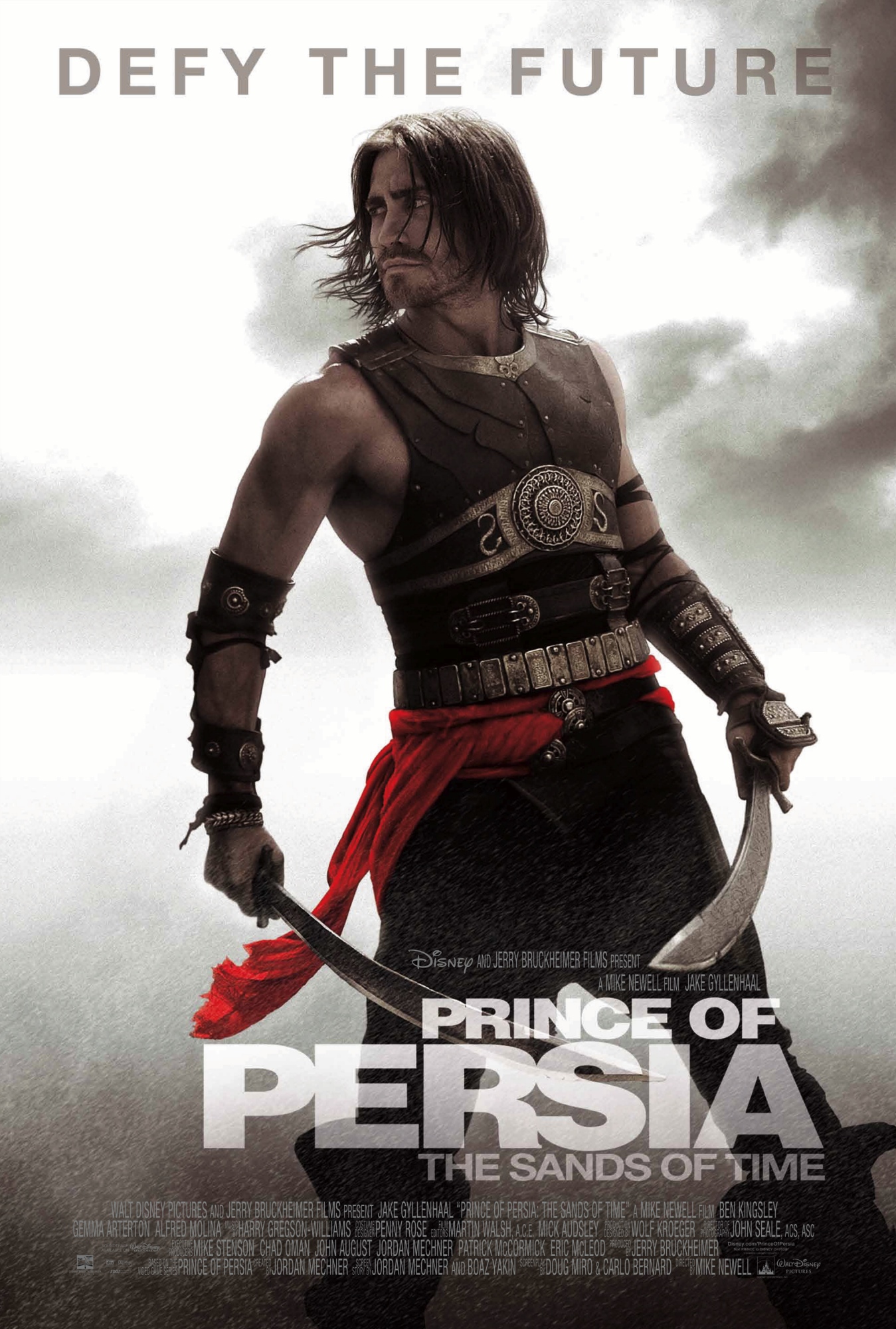
Prince of Persia poster analysis


Immediately the title is visible and is the largest font on the page connoting the importance of the film and how big a film it is going to be.

The date is also in large located directly beneath the title so the first thing your eye is drawn to is the movie title and then you can immediately see when it is out. This connotes how this is a movie that you cannot afford to miss.

The main character is depicted in warrior’s attire wielding two swords. This connotes that there will be a lot of fighting in this movie.

The only part of the poster that is in colour is the red piece of thread around the main character’s waist. This connotes the danger that the main character puts themselves in and that of which he possesses.

The Walt Disney logo is also present above the title of the film. This connotes the size of the film as they are produced owned by a major company known worldwide.

The cloudy dark region behind the main character connotes a dark past which the character is looking away from and into the light connoting he is leaving that dark past behind to do what he sees is right.

The slogan at the top of the poster reading “Defy the future” connotes that time is a major element in this film and that the characters within it struggle to turn a dark past into a better, brighter future.